Poetry in the age of modern media, as these two examples show, can give us a taste for both the world and for its tactile deficiency, a loss that it makes palpable through its material wrapping.
Modes of Transport
Michelle Clayton
University of California, Los Angeles
Matter in large masses must always be fixed and dear; form is cheap and transportable. We have got the fruir of creation now, and need not trouble ourselves with the core. Every conceivable object of nature and Art will soon scale off its surface for us. Men will hunt ali curious, beautiful, grand objects, as they hunt the carde in South America, for their skins, and leave the car– casses as of litde worth.
-Oliver Wendell Holmes,
"The Stereoscope and the Stereograph" (1859)
RETINAL POETICS
In a mid-1927 crónica written from Paris for the Peruvian weekly Variedades, the poet César Vallejo complained about two categories of Latín Americans in Europe who were failing to experience metropolitan modernity properly. The first was made up of those who had installed themselves in París on a more or less permanent basis, but who still clung to their own Spanish-speaking group and concerned themselves only with what was happening at home; their attachment to life elsewhere, which could also be seen as an attachment to the past, excluded them from foil participation in present-day Parisian cultural life. The second group comprised a more historically perplexing category, consisting of Latin Americans who had learned to model themselves after the most modern European practices of tourism on their own Grand Tours, yet who were therefore, paradoxically, incapable of seeing Europe properly:
vienen de paso, recorriendo todo el viejo hemisferio en seis u ocho meses y viéndolo todo a vuelo de pájaro, como en el cinema y en Paul Morand, para no llevar, a su regre- so, sino un álbum atropellado de imágenes confusas, que no ha pasado de la retina y, por consiguiente, se borra antes de desembarcar en Buenos Aires o Valparaíso. (458)
What worried Vallejo about these newly-rich New World travelers was not only the superficiality of their engagement with Europe –reduced to a handful of expected sights–but their inability to retain any sense of the places they had seen, because of their failure to organize their experiences in retrospect. Their experience of Europe, in other words, remained effectively disembodied and present tense, akin to the experience of watching a film; bombarded with information and stimuli, these travelers were nonetheless failing–out of laziness, ignorance, or something more endemically modern–to turn them into memories.
Vallejo's palpable distrust of visuality here-as in his poetry-would seem to set him apart from the beliefs and practices of many of his contemporaries. An important line of modern writing, from Baudelaire through Mallarmé to Apollinaire and Cendrars, makes an internal engagement with visuality central to its aesthetic, constructing a poetics studded with the sights of modernity, illuminated by the blinking lights of enticement in the modern city. Baudelaire's poem "Reve parisien," dedicated to "the painter of modern life" Constantin Guys, suggests–not without regret–that the only possible approach to moder nity is through the eyes: "terrible nouveauté! Tout pour l'oeil, rien pour les oreilles!" As Tom Gunning insists, "One cannot understand modernity without penetrating its passion for images. Images fascínate modern consciousness obsessively, and this modern sense of images comes from a belief that images can somehow deliver what they portray" ("Whole World" 30).
Baudelaire's own production provided the groundstone for much theorizing on the relation between the visual and the verbal in modernity: on the one hand, his intensely scopic poems of city life, and on the other, his art essays, particularly "The Painter of Modern Life" (1863), which enshrined the quick sketch as the mode best fitted to capturing the contemporary, seeming to equate vision with possession. As Baudelaire made clear from the outset of the essay, however, visuality's seductiveness was also potentially its undoing: in an age of reproducibility that made all sights knowable in advance, it tended to inculcare habits of facile apprehension dissolving quickly into oblivion. In his pointed example, the modern subject visits the Louvre on a journey not of cognition but of recognition, concerned only to see those artworks already known from lithographic reproductions, and moving quickly on past them (390).
The felt equation between viewing and possession was further undercut–but also paradoxically intensified–by the awareness of possession's short-lived nature: a "love [...] at last sight" as Walter Benjamin puts it in his reading of Baudelaire's "A une passante" ("To a Passerby'') (324). In the heightened sensory context of modernity, a determinedly modern writing necessarily had to grapple with che question of ephemerality, as each new experience, sight, artistic or technological innovation carne to erase the previous one. This intensified psychological experience of change amid the modern city crowds –cogently delineated by Georg Simmel in his 1903 essay "The Metropolis and Mental Life"–found a formal analogue in the visual medium of film, an art form often presented as coeval with modernity, and whose essence –like the avant-garde– is destructive forwrard movement; as Mary Ann Doane notes, "cinema works by obliterating the photogram, eliminating that which is static" (176). For Baudelaire, writing in the precinematic age, the figure that best incarnated the modern aesthetic was a "kaleidoscope endowed with consciousness" (400): a moving hybrid of man and machine operating as a viewfinder more than as a recorder, opening itself to the contingency of successive experiences, yet –like Vallejo's tourists– retaining little trace of any of them.
Baudelaire's own poetry retained sorne control over this exhilarated sense of constant change through carefully interwoven rhythmic patterns, sinuous syntax, and most significantly, the layering of different levels of individual and collective memory (Terdiman 106-239). The avant-gardes, however, would recast this accident-buffeted, visually-driven presentness as a full-blown crisis in modern subjectivity, mirrored in their poetry's shattered syntax and fragmented temporalities. In 1912, as Hans-Robert Jauss noted, Guillaume Apollinaire composed two threshold poems that opened onto new practices of the lyric: "Zone" and "Lundi rue Christine." The first offers an uneasy oscillation between the mythic and the modern that has none of Anglo-American modernism's confidence in their convergence. "Zone" presents a kaleidoscopic vision of the modern subject, fractured between present and past selves, and often unlocatable among the poem's shifting pronouns. In the section that most interests me here, the poem begins to deploy self-address in order to trick the self into some sense of its own coherence; significantly, it does so in terms that sound like a person leafing through old photo albums-travel albums-to compose a plausible genealogical narrative of the self:
Te voici a Marseille au milieu des pasteques
Te voici a Coblence a l'hotel du Géant
Te voici a Rome assis sous un néflier du Japon
[...]
Tu as fait de douloureux et de joyeux voyages
Avant de t'apercevoir du mensonge et de l'age
Tu as souffert de l'amour a vingt et a trente ans
J'ai vécu comme un fou et j'ai perdu mon temps
There are two reasons for this lyric subject's failure to pull himself together. The first is the replacement of sensorial memory with images, or to put it in Benjaminian terms, of experience with information, which cannot be synthesized into anything other than an awareness of loss (315-16). The second, intimately connected to the first, is the democratization of the modern subject's experience, now seen as unremittingly impoverished, despite –or indeed by virtue of– its much greater range. The half century separating Apollinaire from Baudelaire was marked not only by artistic transformations and technological innovations, but by the expansion of leisure activities at home and abroad-an expansion of range but also of participation, as the mid-nineteenth century saw a shift from travel to tourism, or from ''the practice of a privileged subject undertaking a demanding voyage in search of active experiences" to "the practice of democratized masses signed up for recreational tours in search of distracting experiences" (Amad 100). Developments in communication and transportation technologies suddenly offered the average Western citizen far greater access to images of foreign places-or indeed, to the real thing itself.
The extension and democratization of experience through technologies was beginning to erode the taste-based distinction between the poet and his fellow citizens, who could now affard to trespass-even if only in mediated farm-into spaces and places that the poet had previously sealed off and explored in his imagination. And as the poet in the modern market place fell prey to a generalized sense of indistinction-Baudelaire's poet losing his halo in the street-his voice would begin to change, finding it increasingly necessary to speak far others, and even more so, to speak through them, finding his cadences in the every-day speech of his fellow citizens, or in the languages of modern technology- advertising, film, travel-that spoke their desires into being. In Apollinaire's other major poem from 1912, "Lundi me Christine," the poet completely submerges his own voice in a sonic collage made up of statements overheard in a café (Jauss 46). The modern poetics of contingency and succes- siveness that emerged in this newly mobile, crowd-driven content directly questioned the Romantically-enshrined notion of the lyric, emblematized in the Wordsworthian doctrine of "emotion recollected in tranquility." The axis of modern subjectivity shifts from privare to public, individual to collective, action to distraction. This would have critica! consequences not only far the production of poetry, but far its reception-or to use a term more appropriate to this essay's argument, its consumption. The challenge of the early-twentieth- century -poet was to find a language that would hold the attention of distracted modern readers, and thereby retain a niche in the marketplace, while at the same time undercutting the discourses that exiled poetry to the margins.
These three distinct pressures on the modern poet-the increasing speed and ephemerality of everyday life, the disorienting extension of its frames, and the growing sense of a commonality of experience-were compounded by a faurth, which to a large degree undergirded them: the development and influence of technology in modernity. As Andreas Huyssen argued almost twenty-five years ago, what sets the avant-gardes apart from modernist experiments is thei r embrace of technology, which "played a crucial, if not the crucial, role in the avant-garde's attempt to overcome the art/life dichotomy and make art produc- tive in the transfarmation of everyday life" (9). The thrust of Huyssen's argu- ment has been largely obscured in poetry studies due to a persistent belief that the lyric is the natural enemy of technology-that the latter's objecthood is fun- damentally incompatible with, indeed potentially harmful to, the former's investment in subjectivity. Carrie Noland offers an eloquent counter-argument to this commonplace. Positing that "the technologies depicted as menacing poetry's existence -from the printing press to electronic communications-have turned out to be vital, rather than fatal, to poetry's evolution as an aesthetic form," she explores how "the rise of commodity culture, the advent of cinema, the invasion of radio technologies, or the intrusion of cybernetics into everyday life nuance a poet's understanding of subjectivity and challenge the viability of lyric forms" (13-14). Treating poetry as itself a form of technology, she explores the ways in which avant-garde poets-from Rimbaud onwards-consciously positioned their lyric productions within the marketplace, using poetry to comment obliquely and formally upon changes in the social conditions ofliter- ature.1
To mimic industrial forros, however, was to risk the standardization and mechanization of literature itself.2 Vallejo raised this concern in two articles from Paris in the mid-1920s. In "Contra el secreto profesional" ( Variedades 1001, May 7, 1927) he accused his generation of imitating the clichéd forros of the contemporary European avant-gardes in punctuation, typography, themes, and images. In the more nuanced "Poesía nueva" (Favorables París Poema l, July 1926) he took aim at the kind of poetry that stuffed itself full of the semantics of moderniry without attending to the latter's effects on sensibility:
Poesía nueva ha dado en llamarse a los versos cuyo léxico está formado de las palabras "cinema, motor, caballos de fuerza, avión, radio, jazz-band, telegrafía sin hilos" y, en general, de todas las voces de las ciencias e industrias contemporáneas, no importa que el léxico corresponda o no a una sensibilidad auténticamente nueva. Lo importante son las palabras. Pero no hay que olvidar que esto no es poesía nueva ni antigua, ni nada. Los materiales artísticos que ofrece la vida moderna, han de ser asimilados por el espíritu y convertidos en sensibilidad. El telégrafo sin hilos, por ejemplo, está destinado, más que a hacernos decir "telégrafo sin hilos," a despertar nuevos temples nerviosos, profundas perspicacias sentimentales, amplificando videncias y comprensiones y dosificando el amor: la inquietud entonces crece y se exaspera yel soplo de la vida, sea viva. (300)
This article has generally been taken as Vallejo's rejection of the avant-garde per se. However, I would suggest that it rather contains an urgent call: to rethink forros of representation and experience in moderniry. Vallejo is arguing here for the lyric rendition of a new forro of sensibility that would have little common with the contemplative self-absorption of Romantic poetry, opening itself up instead to the shocks of an increasingly technologized era. In other words, a poetry that would take the risk of submitting itself to the logic of modernity, allowing for the emergence of a new subjectivity glimpsed and experienced in the painful process of learning to accommodate the modern. The kind of poetry that would give the reader a series of physical jolts.
Latin American avant-garde poetry from the 191Os and particula rly the l 920s displays ali of the facets I have delineated as endemic to the European avant-gardes, and should therefore have something to tell us about the experi- ence of modernity (as habit, desire, and frustration) on the continent in the early twentieth century. And yet scholarship has tended to shy away from this type of production, criticizing it as a superficial attempt to portray the disjunc- tures of an imagined modernity through its forro and semantics: a montage of quick impressions, a speed of movement that disavows any lyric absorption in an experience, a barrage of buzzwords of modernity fired at the unsuspecting reader, who is thus reduced to the passive receiver of serial shocks. There are two main reasons for the rejection of this kind of poetry. First, the widespread sense that it grows out of an engagement with European and (to a lesser degree) North American poetry-encountered piecemeal in anthologies, translations, magazines-rather than with local literary traditions; in marking a clear break with prior national or regional modes and connecting itself instead to global processes, it is seen as betraying not only a literary trajectory but also the increasingly politicized imperative of local representation in !iterature. Second, and as a corollary to this: the suspicion that its rendition of modernity is a purely projective one, based on what it imagines to be happening elsewhere, which leads it to neglect the intermittent and uneven processes of moderniza- tion taking place on the Latin American continent. Thus if European writers were responding to a direct!y-experienced tech nologized landscape, Latin American avant-garde poetry looks like a secondhand mimicking of industrial forros, via the purely formal imitation of European models.
This may be a fair description of sorne of the poetry produced i n Latin America in the 1910s and 1920s, which virtually screams its inscription i n a modern mindset picked up from the invasion of various media.3 Rather than simply dismissing this kind of poetry, however, a careful reading (as mapped out, for instance, in Aguilar, Lauer, Rama, Schwartz, or Unruh) can signa! the ways in which this kind of poetry effectively captures the experience of moder- nity in various parts of Latin America in the early twentieth century. It does so, moreover, in a way that complements the realist impulses of the novela de la tierra: what in the latter constitutes content is here recast as form, namely, modernity as both desire and frustration, abundance and intermittency. The modernizing euphoria we note in this poetry produces what we might term a two-speeds effect: a sense that the pace of modern life has accelerated exponen- tially-mimicked in the poetry's manic reference to machines and mass cul- ture-colliding with a sense that that pace has not yet picked up sufficient speed in Latin America. The resulting anxiety issues forth in a kind of referential frenzy, as if the incantatory naming of modern experiences might somehow summon them into being.4 This sense of a projective modernity becomes par- ticularly acute when we encounter these poems within the bounds of an anthol- ogy, such as Grünfeld's enormously useful collection, which shores up so many fragments that it inevitably turns them into ruins, the rubble-strewn landscape of unrealized modernity.
But amidst all of these fragmented invocations, we occasionally find attempts to shape the experience of intermittent modernity in Latin America-to organize isolated experiences into a record with sorne lasting value, by fore- grounding the materiality of the book over its contents. And the impetus for these kinds of experiment comes not, I will argue, from engagements with lit- erary tradition, but from an opening to mass culture.5 An opening that, to be sure, puts lyric poetry under enormous pressure, forcing it to attenuate itself in order to squeeze into the reconfigured cultural marketplace, all the more so when competing with more prestigious products entering Latin America from the metropolis. What is at stake in these early-twentieth-century experiments is poetry's place and function at the nexus of new media and neocolonialism. These works deploy techniques learned from both mass culture and the avant- gardes-specifically, the fragment, and its spatial or temporal arrangement i n montage-to open their reader's eyes and shuttle their bodies toward an aware- ness of Latin America's place in Western modernity. What results is a critica! vision of Latin America's interna! heterogeneities, as well as its relation to the world via neocolonial systems of politics, economics, and culture.6 This poetry produces a self-critical image of Latin America via its circulation (or non-circu- lation) in the global cultural marketplace, training Latin American publics to re- envision the continent's place in the l 920s, and to adopt a critica! eye on their own relation to the local-or rather, to see local and international moder- nity in the same frame, stereo-optically, as juxtaposed fragments.
But first, a short parenthesis on modernization in Latin America, certain aspects of which were far more developed and palpable by the early twentieth century than we might think. Technologies of communication and transporta- tion-epitomized in film and railways or streetcars-had made important inroads into Latin America by the early years of the century, and were part of everyday life in most parts of the continent by the 191Os and through the l 920s. Many of the poets writing during this period were avid-filmgoers, occasionally even pro- fessional film critics (Borges), and their fervent engagement with a mass cultural mode coming to them from abroad leaves important traces in the content but also, as we will see, in the form of their productions. Connected to this was the widespread enthusiasm among writers over increased possibilities for travel, both within the continent and outside it. Well-heeled and well-connected trav- elers from Latin America-such as Borges, Huidobro, or Oliverio Girondo-trav- eled back and forth between old and new worlds with sorne regularity, being vis- ited in turn by prominent European vanguardists, artists, performers, and intellectuals, who were passed from country to country by a developing network of cultural arbiters relying on the newest technological possibilities of move- rrient and communication. The high point of attempts to create these continen- tal networks carne in the l 920s, when transportation and communication tech- nologies-whether in fact or in the planning stages-were reaching their peak.
Many writers, of course, could not afford to travel, and to a certain degree (as in the case of Carlos Oquendo de Amat), film compensated for this, offering a virtual experience of travel for those without the means to visit other countries; as Paris-based translator Francis de Miomandre pithily put it, "el cinema es el transatlántico de los pobres" (cited in Basadre 47). But this was not simply a metaphorical connection: as various critics have shown, there was a significant overlap between travel and film from an early stage in their paral- lel development: not only were lectures on travel frequently illustrated by films, but much early film consisted of moving vistas of foreign locales.7 Early film thus gave viewers across the globe a sense of sudden contemporaneity with other viewers, grounded in a shared simultaneous ability to see other spaces, and perhaps to imagine that they were themselves being seen elsewhere.
This same desire for and delight in the promises of modernity flickers through Latín American avant-garde poetry. But in its engagement with mass cultural modes, it would need to find a way to negotiate their pitfalls, the incul- cated habits of easy consumption and quick forgetfulness; to handle visuality with tact; and to register an awareness or critique of both the shocks and the shortfal!s of local modernity.
POETRY IN MOTION
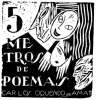
With all of this in mind, I want to focus on two collections that grapple with questions of modernity in un usual formal ways: the Argentinean Oliverio Girondo's Veinte poemas para ser leídos en el tranvía (1922), and the Peruvian Carlos Oquendo de Amat's Cinco metros de poemas (1928). The first is the inau- gural work of a prolific vanguardist and well-heeled, frequent traveler to Europe, who in the early 1920s was primarily associated with propagating a discourse of cosmopolitanism in Argentinean letters. The second, an accordion of seventeen or eighteen poems (severa! stretch across two pages) that unfolds like a film-strip, is the only complete work by an impoverished writer from the Andean town of Puno, who would face política! persecution, misery, and exile before his death in Spain from tuberculosis at the age of 32. Viewed in terms of class position, access to international culture, and connection to specific local cultural politics, Girondo and Oquendo represent polar opposites within the panorama of Latín American poetry. How, then, are we to account for the fact that they are respectively responsible for two of the most important books of the continental avant-garde-and that those works show so many structural similarities?
The answer is found in their engagement with the two mass cultural modes that forro each other's flip-side in the early twentieth century: travel and film. Girondo spent numerous summers of his youth in Europe, acquainting himself with historical sites, holiday resorts, writers, and artists; by the early 1920s, he began to devote himself to more local causes (such as Argentinean literary pro- duction); and in mid-1924 he launched himself on a tou r of the continent- with stops in Chile, Peru, Mexico, and Cuba-conceived as a "mi- sión de confraternidad artística e intelectual [con] la juventud de América y Europa Latina [sic]" (Martín Fierro #7, July 1924). Girondo's travels offered him both a practica! and discursive model for thinking about modernity across a broad panorama that looped Latín America into a large-scale image of the West.
Oquendo, meanwhile, was living hand-to-mouth in Lima, for which-like many writers of his generation-he had left the sierra as an adolescent. Once in the capital he transformed himself into an autodidact, keeping up-to-date not only with contemporary Latín American but French avant-garde poetry i n journals such as Grecia, Cervantes, and Cosmópolis (Ayala 110-34).8 Even more important, though, is the fact that from early childhood he was an avid filmgo- er, which is less surprising than we might think once we realize the rapid pene- tration of film into most parts of Latín America-including the Peruvian sie- rra-by the early 1900s (Bedoya). Oquendo even had a family connection to film-his uncle was the operator of a movie-house in Puno-, which means that we should take with a grain of salt the common critica! assertion that references to film in his poetry constitute a deviation from his Andean experience. As a teenager, Oquendo himself drew up ambitious if unrealized plans for a maga- zine devoted to film-to be called Celuloide and co-directed by the poet Adal- berto Varallanos (Ayala 154)-in an era in which professional film criticism was still just getting off the ground. The widespread enthusiasm for film among writers and critics in Lima in the l 920s would naturally have confirmed his gravitation toward the new medium in his own poetry.
From these significantly different positions, Girondo and Oquendo engage with modernity in their poemarios on a number of overlapping levels, as 1will tease out in what follows. First, in accordance with their own biographical experiences, they model their writing respectively on modern leisure practices of travel and film-viewing, which leave their traces in the form as much as the content of their poetry. Second, both collections explicitly test the limits of poetry in increasingly globalized and mediatized societies, by focusing explicit- ly, as we will see, on questions of materiality and measurement. Third, each one presents their work within at least three different frames, which have to do by turns with questions of visuality, language, and taste, and which clash with one another in unsettling ways. The result is a dramatization-now lighthearted, now bloody-minded-of the quandaries of lyric subjectivity in modernity, as it affects not only the writer, but-perhaps to an even greater extent-the reader. In these two collections, Girondo and Oquendo tiptoe to the brink of what it is possible to do to and with poetry before it dissolves completely in the logic of the market. By submitting their writing to the logic of international moderni- ty-driven by changes in technology, the market, the globalization of commerce and culture, new places and forms of labor, and massified modes of entertain- ment and media-they begin to imagine and experiment with new forms and roles for poetry. And the questions that they raise in the process are absolutely critica! ones: what is the place of poetry in modernity, and inextricably inter- twined with this, what is the time of poetry in modernity?
Girondo and Oquendo were both conscious of producing poetry in an era of technological reproducibility, with inevitable consequences for the poet's role and work-methods. In Veinte poemas para ser leídos en el tranvía, lyric sub- jectivity occasionally flickers up only to register its pre-technological inadequa- cy, its inability to record sights seen: "Pienso en dónde guardaré los quioscos, los faroles, los transeúntes, que se me entran por las pupilas. Me siento tan lleno que tengo miedo de estallar ... Necesitaría dejar algún lastre sobre la vere- da" ("Apunte callejero"). Oquendo, on the contrary, seems to celebrate the fact that "todos los poetas han salido de la teda U de la Underwod [sic]" ("réclam"). In the startling footnote to the poem "film de los paisajes," he even recasts poets as machines for a new kind of revelation, capturing "los poemas acéntri- cos que vagan por los espacios subconscientes," to be replaced in the near future by "aparatos análogos al rayo X."
Girondo and Oquendo both handed over their own collections to typeset- ters, but they also made sure to involve themselves to an unusual degree in the assembly. Girondo brought out his Veinte poemas para ser leídos en el tranvía in France in a luxury edition in 1922, and contributed directly to its material com- position: selecting paper-type, fonts and typography, and, most strikingly, including ten pastel sketches by his own hand, interspersed among the twenty poems that make up the collection, occasionally invading their spaces. As he complained two years later in an (anonymous) note in the journal Martín Fie- rro, this first edition met with limited response in Argentina; in an effort to extend the collection's reach at home, he produced a cheaper and more portable "edición tranviaria" or pocket-paperback three years later. The collection itself takes the form of a travel diary, and its twenty poems cover an immense ground: from Europe's major tourist destinations (Brittany, París, Biarritz, Venice, Verona, Pallanza, Seville), through beach resorts closer to home (Rio de Janeiro, Mar del Plata), to local neighborhoods of Buenos Aires, their squares and cafés, with an unexpected stop in Dakar, port-of-call on the route between Europe and Latín America. Theverve and originality of Veinte poemas clearly owes much to its author's familiarity with both the established cultures and newest tech- niques of Europe-and to his ease of movement between Old World and New. Oquendo de Amat's Cinco metros de poemas has far more humble and local roots, which might seem to be reflected in the poems on domestic themes and love affairs that make up more than half its contents. However, in its remaining poems it travels far and wide-from the Andean highlands through urban spaces (often unidentified, but also New York, París, and Vienna) to the port of Antwerp-across an animated landscape of Western modernity. This seemingly euphoric intertwining of local and foreign views by a writer from an Andean region, writing in a period of intense cultural indigenism, has over the years been greeted with sorne discomfort by critics, who have read it as an instance of false consciousness brought on by the encounter with an externally-im posed and incomplete modernity. Yet there is little in the collection that justifies tak- ing the "local" poems as more authentic than those that focus on modern cities or on foreign views; instead, the always latent presence of mediated mass cul- ture suggests that the Andean idyll subsists as a pocket of experience inside a broader experience of modernity, and that to separate them out is to do vio- lence to the reality of a context increasingly organized by and within global mass culture. This is reaffirmed in the collection's very form, which unfolds like a filmstrip and thereby tethers together its disparate contents.
Cinco metros de poemas was begun in 1923, when Oquendo was just eight- een years of age, and completed two years later; it was finally published in Lima in 1928. Given bis age and his economic situation, Oquendo necessarily lacked Girondo's access to actual travel; however, he was no less avid a consumer of foreign views through film, and he seamlessly blends the two together in cer- tain images in bis poetry, as in "film de los paisajes," which might be describing a tour through European cities ("París habrá cambiado a Viena''), were it not for the reference to pushing a button, and the later statement "se ha desdoblado el paisaje," which intimates that the lyric subject is looking through a stereo- scope. Oquendo sees double, we might say, because-unlike Girondo-he can- not afford to see directly. Yet Girondo also underlines his awareness that vision in modernity involves reproductions and reflections; and that it has a cost. The experiences his poems offer are available for the price of a transatlantic passage, or of a postcard for those who cannot afford to travel (indeed we might view the illustrations that accompany the poems as postcards). The tourists who appear in the poem "Croquis en la arena'' are even offered a snapshot of the very sight that they are viewing at the moment in which they view it, turning their experience into a purely retina! one, whose material vestige will nonethe- less hopefully outlast the moment.
Readers familiar with the European avant-gardes might be tempted to think that the formal innovations of both Girondo's and Oquendo's collections stem directly from the examples of European precursors and contemporaries: Mal- larmé's play with the materiality of the page, Marinetti's accent on technologies and typographical experiment, Apollinaire's calligrammes and urban scenes, or Cendrars' meshing of travel narratives and painting in the collaborative Prose du Transsiberien. Sorne of these experiments would certainly have been known to Latin American writers in the 191Os, through commentaries and transla- tions in major newspapers such as Buenos Aires' La Nación or Lima's El Comercio, not to mention through quickly circulating magazines such as the Spanish Grecia or Cervantes. Time lag, however, complicates the tracing of these kinds of parallels. Mallarmé's Un coup de dés did not appear in Spanish until Rafael Cansinos Assens published bis translation in Cervantes in November 1919; Apollinaire's "Zone" was not translated until 1926, when it appeared in Martín Fierro. (Many writers, especially those who-like Girondo-spent time in Europe would of course have encountered both previously in French.) But more signif- icant-not to mention more interesting-is the question of what gets lost in translation when translation does occur. In the case of the more formally experimental European avant-garde productions, what disappears is often precisely form. Cendrars' Prose du Transsiberien, whose dovetailing of image and text would seem to provide a model for Girondo, and whose unfolding form seems to directly undergird Oquendo's Cinco metros, appeared in Grecia in fragmen- tary form and as a purely textual prose poem in January 1919-bereft of its images, its typographical play, and its material base, leaving behind only a ver- bal skeleton that bears little relation to Girondo's and Oquendo's experiments. Another trait that seems to link these two collections directly to a contem- porary, broadly Western aesthetic is their formal commitment to the fragment, generally accepted as a central procedure of the European avant-garde (Bürger; Nochlin). The abundance of fragments in each of these collections-both on the level of individual poems and in the fragmentation rendered within the poems-might also signa! the necessarily fragmentary nature of a Latin Ameri- can viewpoint, receiving images and reports of metropolitan modernity either piecemeal (through travel, as in Girondo's case) or secondhand, through trans- lations, journals, and anthologies, advertisements for travel, foreign inform- ants, and/or film (Oquendo's case).9 Yet the fragment is not simply a literary or artistic discovery, and it is not confined to the avant-garde, whether European or Latin American; it functions as the centerpiece of a whole series of organiza- tional practices of mass cultu re in modernity, from museu ms and libraries through photography and film, through travel by train, automobile, or steamship, trickling down to generalized domestic practices of personal collec- tion (scrapbooks, albums, stamp collections). Experiences of modernity may be fragmentary, but its subjects tend to reorganize those experiences into wholes; even Vallejo acknowledged that the tourist's füst impulse is to compile a mental album of sights seen-even if those albums, remaining purely virtual, have no lasting organizational effect.
I would suggest, then, that what more directly explains the coincidences in procedure between the differently positioned Oquendo and Girondo, and with their contemporaries in Europe, is their simultaneous exposure to technologies of the modern. Their engagement is less with prior lyric renditions of modern experiences than with the reshaping of the average subject through the mass cultural practices of modernity; their conversation less with literary history than with contemporaneous technologies that were transforming the sensibili- tles of readers and authors alike. In the period under discussion, everyone was touched by film, and everyone imagined traveling-and the iconography of film and tourism (in the form of ads and postcards) offered far more enticing models for leisure than did poetry. By modeling their collections on the modes of travel and film, Girondo and Oquendo offer a commentary on modern mass culture, and suggest that leisure time might most profitably-I use this word deliberately-be spent reading poetry.
Veinte poemas and Cinco metros de poemas both present exaggerated scenes and sensati0ns of moderniry, at home and abroad, and both are composed of fragmentary invocations of particular experiences, sights, and spaces. Yet their modes and moods are markedly different. Girondo structures his poems by ref- erence to mass tourism (or the promise of mass tourism, which from a Latín American perspective was still only available to elites). Individual poems offer snapshots of foreign tourist destinations (Venice, Verona, Biarritz, Brest, Seville, Dakar) or momentary renderings of sites closer to home, which have their own picturesque appeal (a milonga, a cafl-concierto, the barrio de Flores). These are snapshots of modern desires, which aim, as severa! critics have noted, oth to desntimentalize eroticism and to dismantle any possibility of roman tic 1mmers10n In a landscape, a !ove affair, an experience. Lyric subjectivity flares up remarkably rarely, and then only to underline its weakness ("Apunte calle- jero") or to submerge itself in a much larger "nosotros" or an impersonal "se" ("Nocturno"). More than by a lyric subject on the move, Girondo's collection is linked together by the viewpoint of the roving eye; his intensely voyeuristic omniscient narrator-a "kaleidoscope endowed with consciousness," in Baude- laire's phrase-maps out the physical movements of mass tourism and the inner movements of desire, in a series of poems that fix on public places and tear the most intimate rlations out into the open. In these poems everything, even interna! organs, is on the verge of spilling out of its container, subjected to the "miraa corrosiva'' of the public ("Café-concierto") that "ensucia las cosas que se exhibe en lo escaparates" ("Pedestre"). The viewpoint of these poems entangles itself w1th the massed subjects of modernity, ali of whom, while con- suming one another's body parts, teeter on the brink of falling to pieces: the beach scene of "Croquis en la arena" is notoriously made up of:
Brazos.
Piernas amputadas.
Cuerpos que se reintegran.
Cabezas flotantes de caucho.
These subjects lose parts of themselves in either the rush or the leisure of the modern city (in "Apunte callejero," "al llegar a una esquina, mi sombra se separa de mí, y de pronto, se arroja entre las ruedas de un tranvía"), and they risk having the external! world crash into them, or collapsing together with and in it, as at the end of "Milonga," in which "un enorme espejo se derrumba con las columnas y la gente que tenía dentro." These subjects are barely held togeth- er by the onrush of momentary desires, which entangles them with the objects-human and inhuman-in their surroundings, turning them into mech- anized versions of themselves as they imitate those surroundings (in "Plaza," a pregnant woman "hace gestos de semáforo a un vigilante"); meanwhile objects themselves take on human attributes and desires, like the streetlam p of "Pedestre," which, although "apagado," "tiene la vision convexa de la gente que pasa en automóvil," outliving the human subjects whose only determination is to leave a residue of themselves in this violent world.
I emphasize the grotesque aspects of the collection here, but it has to be noted that for all its violence, there is an uncanny lighmess to the Veinte poemas. This is pardy a function of the constantly moving viewpoint, but also of the pastel sketches that accompany half of the poems in the collection, revealing Girondo to be an avatar of Baudelaire's "painter of modern life," distilling the fashions and sensibility of a particular moment in the determinedly minor art of the sketch. In certain moments of mise-en-abyme in individual poems, images of what is being viewed are offered for sale, through the lens of a degraded eroticism that suggests that everything is for purchase; "Croquis en la arena'', for instance, refers to pho- tographs that sneak close-up shots of female bathers, and then reproduces such an image as a sketch within the poem itself. This may tell us something about an unchanging demand for views of female bodies, but it more crucially points to modernity's capacity to cover over the experience of fragmentation with a prom- ise of wholeness, "reintegrating" broken bodies and fragmentary experiences by producing packaged and eroticized versions of a fleeting sensation. This packag- ing even affects or shapes the public spaces where modernity is to be experienced: squares and café concerts, amusement parks and world's fairs, or for those restrict- ed to vicarious experience, the humble form of a postcard.
Girondo's lighthearted excoriation of modernity is particularly surprising in that these poems deal not with rationalized workplaces- an easy target for attack–but with leisure sites: from European tourist destinations to pleasure resorts closer to home, all of which consist of public spaces where vestiges of intimacy or privacy are simultaneously co-opted and torn to shreds. Veinte poemas presents the modern mass subject at play, in leisure times and spaces that are completely subject to and scripted by modern mass culture. If the modern workplace is committed to the training of bodies, spaces of leisure are organ- ized toward the training of desires. And the only desires of the modern human subject, in these poems, are for momentary possessions of the people or things in their surroundings, for periods of numbness and amnesia toasting in the sun, and for packaged mementoes of their experiences. This mediatically–shaped world, in other words, is mediated through and through. There is no outside to this world, but also, effectively, no inside. Everything is already over-exposed.
For this reason, the poems do not reach toward a heightened experience on the part of a privileged lyric subject, but remain resolutely at the leve! of habit- ual experiences of indistinct mass subjects in their places of leisure. There is barely any personal recollection in these poems, only a depersonalized stenog- raphy that registers the components of a given scene and preserves them, so that they can be recognized by readers who might imagine their way into them, as a way out of their own workaday routines. For all the oddness of their images, these poems quite consciously mimic the structure of the promotional tourist ad: interpellating their reader with the promise of the kinds of things to which any modern subject is entitled and, implicitly, that they have earned through their work. Committed to a relentlessly enervating present tense, in which each moment and each view supplants the last, the poems cover over the emptiness of experience with promises of new forms of leisure and desire, to be realized only through constant movement. Thus the collection rushes from point to point in its world tour, stopping only briefly for respite at the port- town of Dakar in Senegal, historically an important trading-post, whose histo- ry contains both foodstuffs and the slave-trade: traffic in desires and in bodies. But this is implied rather than stated; the poems present, with a finely-tuned irony, a string of destinations whose history has been erased, and whose func- tion is in turn to erase-however momentarily- the memory of the tourists who visit them. For this reason, Veinte poemas deals-at least on the surface-not in recollection, but simply in collection, seeming to buttress Vallejo's point about tourists and their ephemeral albums-although as we will see, this is only half the story.
Oquendo, by contrast, shuttles back and forth between different rhetori- cal modes, sentimental moods, and modern scenes. Cinco metros de poemas runs a gamut from love poems ("aldeanita") to dream/ nightmare sequences ("cuarto de los espejos") to imaginary travel ("new york," "amberes"), mixed in with mediation by forms of film and advertising. Roughly half the poems in the book-those addressed to a lover-feature a still-recognizable lyric sub- ject, although one who repeatedly stresses his desire to be bound, which hints at an imminent dispersa! of subjectivity. Others render scenes of modernity with no explicit experiencing subject-or rather, a subject who defines himself by his similarity to other viewers, whether in sharing memories of cowboy films watched in childhood ("film de los paisajes"), or imagining his counter- parts i n the office-workers peering out the windows of a modern skyscraper ("new york"). In these "modern" poems, Oquendo paints a shared landscape mediated and shaped by film and advertisi ng, which is somewhat sunnier- even if its lighting is often artificial-than Girondo's tourist hotspots. The sun no longer illuminates the landscape, but rather reads it, through the windows of the streetcar in which it travels ("Desde un tranvía / el sol como un pasajero / lee la ciudad"), while the absent moon is envisioned not as spa- tially elsewhere-on the other side of the globe-but simply as "de compras." Both of these images are from the fourth poem, "réclam," which emphasizes the ways in which urban space is "capitalized" through and th rough: ren- dered in block capitals, and conceived of in terms of cost or profitability. And when the human subjects of Oquendo's poems go traveling (to two histori- cally differentiated centers of trade, New York and Antwerp) their desires are thoroughly mediated by what has already been packaged for them i n films and advertising-skyscrapers, billboards, celebrity culture-, which in turn invade and shape the poem. Oquendo, however, provocatively inverts Vallejo's point about Latin American travelers to Europe, or indeed our expecta- tions of cultural hierarchies as manifested in modern tou rism: when his desirous tourists step off the boat in Antwerp, with "ojos receptivos de celu- loide," they are avidly watched in turn by European natives, who "leen en sus ojos paisajes de América"–eeing them as the carriers of faraway cultures, film-vistas made flesh.
There have been repeated attempts over the course of the collection's reception history to make it cohere into a kind of Bildungsroman, following a young protagonist from his Andean home through the excitement and then the alien- ation of the modern city (presumably Lima, although never identified as such) and eventually to his chastened, even embittered, return home. 10 But this kind of reading depends on two questionable assumptions: first, that the Andean space remains effectively untouched by modernity, even by film; and second, that there is no cross-contamination between the poems on domestic and on odr thmes. Coronado argues, for instance, that the former type of poem 1mphc1tly Involves an Andean setting, presents no formal or stylistic experi- mentation (83), and represents for the poet "a moment previous to modernity" (85). Yet it is decidedly difficult to separate out the spaces evoked by these poems, as the modes of one begin to bleed into the other, nature and culture cross-ollinating one nother: in "compañera," for instance, the beloved's rosy cheek is sweetly descnbed as "un cine en la mejilla" –which is hard to read as a modern perversion of innocent beauty.
Even at the quantitative level of the collection we perceive a degree of wavering in the separation and formal treatment of these spaces. How many poems are there, in fact, in Cinco metros de poemas? Conventional wisdom counts eighteen: four from 1923, fourteen from 1925, held apart by an inter- mission'. in the 1925 group, three poems explicitly engaged with rendering modern1ty as landscape ("film de los paisajes," "new york," and "amberes") stretch across two pages. They announce this stretching in their very titles, "".'hich ar indeed spread across the span of the poem, and this typographical s1gnpost is buttressed by the fact that each poem is held together not so much by narrative as by stylistic coherence. But what about the two poems "poema" and "obsequio"? Appearing on facing pages, both addressed to a lover, and both diectly concerned with questions of economy and the gift, could they not be sa1d to make sense as a single poem, a "poema obsequio" that subtracts itself fr the economy of exchange value governing the poems on modernity? If th1s is the case, this leaves us with a poem that deliberately counters other poems on urban themes by mimicking their form while subverting their econ- omy-a case of nature, or primitive economy, reclaiming the space of civiliza- tion, like the trees about to break their bounds in "new york."
Nonetheless, the fact that the collection begins and ends in the countryside, made co-extensive with the space of the maternal (the poemario 's dedication to the poet's mother answered by the poems "madre," "campo," and "poema al lado del sueño"), tempts us to try to make a narrative out of the whole. Indeed, the collection incites this temptation in its repeated references to "cintas." But the very ambiguous deployment of this term paradoxically also offers the most clear-cut argument against the posited (Andean) nature/(Western) culture divide in Oquendo's poemario. In the opening poem, "aldeanita," the "cinta" is a ribbon with which the poet hopes to attach his heart to the lover's braids. In the poem "puerto," however, the cinta reappears in the hands of a drunken sailor in the form of "cintas proyectadas de infancia"; followed by one of sever- a! references in the collection to cowboy movies, this would seem to be a refer- ence to films seen in childhood-a childhood in fact saturated by movie-going. Like so many other nouns circulating through this collection (trees, birds, song), the term is associated with child's play but also-albeit to more surpris- ing, even avant-garde effect-with modernity, effectively suturing them together rather than subjugating one to the other.
A more theoretical frame has to do with a maturation of vision: beginning with the beloved's "ojos nuevos" in the first poem (a gift for the lover –"dos reales"– in an alternative economy), moving through blindness in the second poem, to the lover's newborn eyes in the third-at first "niños" (a play on "niñas" as pupils), but which soon "visten pantalones largos" –through to the "miradas internacionales" that puff out of perfume albums in the fourth. This will lead to a radical expansion of vision in subsequent poems, allowing the lyric subject to see Peru and the world within the same viewfinder – and to reílect on the common fate of the world in modernity, which is to become itself a reílection or a reproduction (in the same poem, the earth is being screened via satellite from the moon, in an eye-opening pre-televisual image).
At work in both collections, in other words, is an international vision that never loses sight of the specificities of the local (be it European or Latin Ameri- can), while at the same time emphasizing (for good and bad) a commonality of experience resulting from the transnational migrations of modern mass culture. The attempt to keep multiple spaces in view at once finds a formal analogue in the organization of the collections themselves, their tension between internal fragments and external packaging.11 The attempt to harness the fragment for a narrative or a collection never fully domesticates the fragment itself, but nor does the explosive or anarchic character of the fragment fully escape the gather- ing power of the collection-be it scrapbook, photo album, film, or museum. In the context of the two Latín American poetry collections under discussion, the orm in which their fragmentary contents are gathered points at one and the same time to the disjunctive experience of an intermittent modernity, and to the attempt to turn those experiences of shock into a lasting source of informa- tion. Or into a lingering sensory residue, the formal and material trace of poetry.
This is what particularly interests me about Veinte poemas para ser leídos en un tranvía and Cinco metros de poemas. What is most important about these two collections, I would suggest, is not the individual poems they contain, but rather the containers themselves, the careful organization of their fragmentary contents into wholes. The unit of composition in both collections is not the verse, as in conventional forms of metrical poetry: Girondo oscil!ates between free verse and, more usually, prose poetry, and moreover accompanies half of his poems with images, while Oquendo experiments more ostentatiously with typography, both in the shape of words or phrases and their relation to the space that surrounds them. Nor is it quite the page, as in concrete poetry, which turns the poem into a kind of contained force field. The unit of meas- urement here is rather the book. Both poets present their collections as material objects to be experienced sensorially, flipped through or unfolded, seducing the reader with visuality and tactility, a point emphasized through their various framing discourses. Modernity appears here more crucially on the level of form rather than content, and this has to do with both poets' attempts to rethink both the place and function of poetry. To do so required submitting their poetry to the logic of modernity, mass culture, and the market, testing its capacity for resistance, through a risk that brings their poetry to the brink of an ironic dispersal.
This is announced in the very titles of the collections, which mark a curious break with their contents. Girondo's Veinte poemas para ser leídos en el tranvía actually focuses not on the streetcar of its title, but on local and international tourism. The streetcar nonetheless haunts the structure as an organizing metaphor, a signaling function, and a place of consumption: a reminder of the demands of work and of a grinding routine that nonetheless has gaps that need to be filled. Not the gaps of lunch breaks, of workday's end, of weekends, or of structured holidays-pockets of time for consuming food, entertainment, travel- but the empty time of commuting to and from work. By giving the tram a definite article, Girondo makes it clear that he is presenting not poetry that needs to be read in a particular space (the reader's body shaken by the motions of the tram, a kinaesthetic accompaniment to lyric commotion), but poetry as a filler for time spent on the tram.12 With an ironic or perhaps a sarcastic wink, Girondo offers his poems as a stopgap for this empty time, replacing the newspaper or awkward stabs at stranger intimacy with refuge in a lyric that is sketched quickly to be consumed quickly, between the beginning and end of a journey by streetcar (Schwartz 143). The central argument for the lyric here is that it is bite-sized.
Yet the demands placed by Girondo's lyric on its readers are not squared away so easily; they linger in the unsettling images of the poems, in the violence rendered in its lines and its accompanying sketches, and in the very friction between the form of the collection and its contents. These poems involve constant shuttling from place to place, and there is little logic governing their overall organization; what looks initially like careful dating is soon undone by sorne chronological inconsistencies and impossibilities (Schwartz 140-43). There is no explicit link from place to place, poem to poem, although sorne sites recur; much less any sense of arrival at or departure from sites visited. There is only a being there, in the moment, which will soon be replaced by another moment, then another, following only the logic of the streetcar and its stops. Most importantly, whatever compositional logic the collection ostensibly has would suggest that it is potentially illimitable; there is no need for the col- lection to screech to a halt in Seville, nor indeed at the limit of twenty poems, other than the poet's decision to apply the brakes at a certain point-having reached the end of the predetermined line. (Ramón Gómez de la Serna, in a prescient early review of Veinte poemas, joked that he had tested the collection' logic by reading it on a streetcar, but found that it took longer to finish tha suggested, which forced him to buy another ticket).
Oquedo's Cinco metros de poemas states this logic even more baldly. Consistng of just seventeen or eighteen poems and one oddly-placed intermission (which might itself count as a poem, almost matching Girondo's total of twen- ty), this collection's market-value is determined by sheer quantity, sold by length-like a roll of fabric. Or, indeed, like a film-strip, albeit an extremely short one (eleven seconds long), in what may be a sarcastic allusion to Peru's ailure to properly finance its film-industry, holding it hostage to films shipped m from abroad. As in Girondo's streetcar, the only connection between individual poems is one of contiguity; the collection leaps from subject to subject, place o place, held together only physically, in their unfolding form. These collecti0ns of fragments remind us of formal parallels between the railway-carriage (here brought down to the smaller level of the streetcar) and the filmstrip, each of whichike multi-destination mass tourism-pulls together various sights by rendermg the transitions between them invisible to the human eye (Schivelbusch; Kirby).
The titles of both collections, then, announce a double frame-travel/film and measurement-that both complements and clashes with their contents. Their epigraphs complicate this framing still further by introducing two new iscourses: language and consumption. The 1922 edition of Veinte poemas included adedication to Girondo's elite companions at the gastronomic club "La Púa," throuh which he made a pointed case for cosmopolitan consumptton habits, assurmg his peers that en nuestra calidad de latinoamericanos, poseemos el mejor estómago del mundo, un etómago ecléctico, capaz de digerir, y de digerir bien, tanto unos arenques septentnonales o un kouskous oriental, como una becasina cocinada en la llama 0 uno de esos chorizos épicos de Castilla.
The 1925 edition of Veinte poemas added a prologue: the "Carta abierta a La Púa." This explanatory note emphasizes Girondo's commitment to an Agentinean idiom-a "fe en nuestra fonética"-but it also complements and re.mflects the 1922 dedication. If in his address there was a prívate nod to an lite gastronomic group, his accent on a local ability to consume the cosmopol- 1tan, the mass-market edition of 1925 turned an exclusive sobremesa into an en conversation. More scandalously, it now suggested that the collection 0cntained not only delicacies but also the unappetizing, even the indigestible, and was in effect coming down to street level. The aim of the Veinte poemas, Girondo now stated, was to elevate the everyday and to rescue waste: "y se encuentran ritmos al bajar la escalera, poemas tirados en medio de la calle, poe- mas que uno recoge como quien junta puchos en la vereda." This harmonized better with the collection's goal, as hinted at in the original epigraph "ningún prejuicio más ridículo que el prejuicio de lo sublime": to demythicize the lyric sublime, to bring it down to ground-level, to the unsettling urban street, producing instead what Vicente Huidobro, in his 1925 manifesto "El creacionismo," would call "un sublime de bolsillo," an oxymoron that perfectly encapsulates the ironic form of the 1925 edition.
The epigraph and dedication to Cinco metros de poemas, by contrast, are distinctly unassuming, pointing to Oquendo's very different politics of both language and taste. Rather than charging his writing with any project of local representation, Oquendo simply dedicares "estos versos inseguros como mi primer hablar a mi madre"-a mother in place of a "patria." And the epigraph to the collection, rather than assuming a restricted audience of initiates, contai ns a thoroughly disarming direction: "abra este libro como quien pela una fruta," which, like the ending of Apollinaire's "Les Fenétres" ("La fenétre s'ouvre comme une orange / le beau fruit de la lumiere"), opens the poem wide. Needless to say, unlike Girondo's address to "La Púa," it also references a humble eating practice. Each one of these epigraphs, then, links the writer's taste to that of his readers, but the differentiation between the two on the basis of taste will be mimicked in the kinds of journeys and entertainments imagined within each collection.
Oquendo's epigraph might seem less ambitious than Girondo's project, yet its introduction of a new metaphor for the collection-adding fruit to film–brings the body back into the reading process, making the visual tactile. He offers the reader here not only a film to be viewed or journey to be imagined, but a material object to be touched: a peelable fruit, part of whose point is the pleasure derived from the unpeeling, whether in strips or in swathes. While peeling the skin of Oquendo's fruit, are we more drawn to the separable mate- rial casing, or to what it conceals? Does the delight inhere in the eating or in the peeling? Introducing a metaphor that seems to be external rather than inter- na! to the text, Oquendo prompts us to reílect on whether the meaning of the collection resides in its contents or its form, intimating at the same time that the place of the lyric is necessarily shifting from prívate to public, from elite pastime to common pleasure.13
If the experience of mediated modernity is the loss of all interiority, then by showcasing externall wrappings and. material functions Oquendo's and Giron- do's collections seem to be trying to give poetry a new function: turning it not so much into a decorative object as into an experience that can be consumed without fully exhausting itself, whose sensory appeal can linger. Poetry in the age of modern media, as these two examples show, can give us a taste for both the world and for its tactile deficiency, a loss that it makes palpable through its material wrapping. Once the consuming is over, we are left with the peel: a residue, an excess, a bit of waste that we might unthinkingly throw on the pave- ment. Which the next modern poet-passerby might then pick up, recycling the detritus of modern mass culture into poetry.
NOTAS:
1 One such figure is Gertrude Stein. In 1934, she made the surprising claim that the auto- matic nature of her writing was external rather than internal-structured not by the movements of the subconscious mind, but by the rhythms of modern technology-and necessarily so, since "any one is of one's period and this our period was undoubtedly the period of the cinema and seriesone is of one's period and this our period was undoubtedly the period of the cinema and seriesproduction."
2 This danger was noted by a number of Latin American writers in the early decades of the century, particularly those who experienced metropolitan modernity firsthand. The Rubén Darío of "no imitar a nadie, y menos a mí" complained in 1909-in an article reviewing Marinetti's futurist manifesto-that new forms of writing were turning culture into a kind of global repeating machi ne. In the mid-1920s, Chilean Vicente Huidobro attacked the celebration of machines in poetry-"los poetas que creen que porque las máquinas son modernas, también serán modernos al cantarlas, se equivocan absolutamente"-, yet he cast poets as bi-directional transformers who both extended receptive antennas to the world and electrically transmitted their own insights back into it. His own model of creacionismo is industrial through and through: he ceaselessly repeated his own formulae for producing new poetic products, while approaching the issue of his founding of creacionismo as a question of industrial patent.
3 I am referring here to the kind of poetry immediately recognizable for its coincidence with the European avant-gardes along the lines delineated by Vallejo. There are of course plenty of other experiments that resist easy assimilation under the rubric of any particular movement (e.g., José María Eguren), or that appear as a strange hybrid of different forms, such as Peruvian techno- indigenism, or Argentinean neo-criollismo.
4 This practice resonares with Trotsky's classic argument (reiterated by Berman) that "peripheral" modernisms tend to be shriller than their metropolitan counterparts due to their intermittent experience of modernization coupled with their increased desire for it.
5 I am following here a suggestion made severa! years ago by Gonzalo Aguilar (1996), but not yet taken sufficiently seriously: that the Latín American avant-gardes are preoccupied not with following the European avant-gardes' critique of art as instituúon, but with understanding and shaping art's relationship to mass culture.
6 For further reflection on this question, see Fernando Rosenberg.
7 As Lauren Rabinovitz points out, Hale's Tours effectively brought the two forms together, screening movies in immobilized theater cars (within amusement parks) that gave viewers a sense of actual train travel.
8 Although I do not have space to address this question here, it is time to add nuance to Jahan Ramazani's pioneering work on traveling poetry, recognizing that circuits of influence are not only monolingual and/or determined by colonial histories.
9 For a provocative analysis of the relation between fragments, mass culture, and "positional- ity" in the Latin American avant-gardes, see Rosenberg, especially pp. 12-48.
10 Jorge Coronado's study offers the most intelligent and nuanced version of this story.
11 Tom Gunning has recently revisited his argument about the definitive passage from the "cinema of attractions" to "narrative cinema" around 1907, positing instead that the two modes continued to coincide in the subsequent two decades of silent film. The "shock" of the fragment, in other words, tended to coexist with the "flow" of more orchestrated forms; rather than taking one or the other as emblematic of the 191Os and 20s, it is more useful to think of them in dialectical interrelation, as in the piston of the gasoline motor, in which "a contained explosion is con- verted into consistent motion" ("Modernity" 310).
12 The London Tube series "Poetry on the Underground" (from 1986), followed by the New York "Poetry in Motion" (from 1992), are versions of the same proposition, offering poems to be consumed quickly on the way to work. The French poet Jacques Jouet, in his Poemes de métro (2000), inverts the procedure, insisting on the creative possibilities of producing poems on the metro, in accordance with a series of rules (composing poems mentally between stops, writing them down while immobilized). My thanks to Thangam Ravindranathan for drawing my attention to this.
13 Oquendo's play with form and content has a beautiful echo in Brian Kim Stefans' eleven- minute-long digital poem "The Dreamlife of Letters" (2000), in which words in black or white type flash, leap, spiral, and spin against an orange background.